Architecture Overview
POCO DataSet architecture describes how the library fits into an application as a neutral tabular data layer. The goal is not to impose persistence, UI, or domain modeling choices, but to provide a clear and predictable container for tables, rows, and metadata that can move safely between application layers and modules.
Architectural boundaries
A useful way to think about POCO DataSet is in three layers: the core, the integration layers, and the external systems.
- Core layer (inside POCO DataSet) - DataSet, DataTable, DataRow, ColumnMetadata. This layer is intentionally small and predictable.
- Integration layers (optional companion libraries) - SQL Data Adapter, EF Core bridge, and serializers. These connect external systems to the core model.
- External systems (outside POCO DataSet) - databases, ORMs, UI frameworks, business logic, validation engines, and network transport.
Internal structure (core layer)
Inside the core layer, POCO DataSet uses a simple object graph: a DataSet holds named DataTables, a DataTable defines schema through ColumnMetadata, and DataRows carry the actual values. Schema (metadata) and data (rows) are separate but linked through the table.
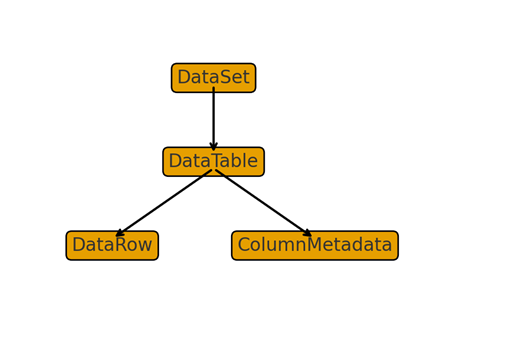
Component relationships (inside the core)
- A DataSet is the root container holding multiple DataTables.
- Each DataTable defines its schema using ColumnMetadata.
- Each DataTable contains multiple DataRows representing actual data.
- Schema (ColumnMetadata) and data (DataRow) are intentionally separated but linked through the DataTable.
Integration layers (how POCO DataSet connects to the outside world)
POCO DataSet itself stays neutral. Integration is done through companion components that translate between external systems and the POCO DataSet core model.
- SQL Data Adapter — loads schema and data from SQL Server into DataTables, and can translate changes back into database commands.
- EF Core bridge — supports workflows where POCO DataSet is used for transport and UI, while EF Core remains the persistence layer.
- Observable integration — provides reactive wrappers around DataSet, DataTable, and DataRow, enabling UI frameworks to observe changes without coupling the core model to any specific UI technology. The observable layer does not replace the core model. It decorates it, preserving architectural separation between data representation and UI concerns.
- Serialization — converts POCO DataSet to / from JSON for APIs and client / server round-trips.
Typical data flow
In most applications, POCO DataSet is used as a data exchange format across boundaries: services provide a DataSet to the UI, the UI modifies it, and only the delta is sent back.
- Load: external source provides schema and / or data (SQL, EF Core, API).
- Use: application layer components read and update DataRows based on ColumnMetadata.
- Track: row state and change tracking identify what changed (modified / added / deleted).
- Return: a changeset or delta is sent back through an adapter / bridge for persistence.
- Refresh: updated server values can be merged back into the client model (refresh / post-save workflows).
What the architecture deliberately avoids
Keeping boundaries clear is part of the design. POCO DataSet intentionally avoids:
- Owning persistence — it does not replace databases, repositories, or EF Core.
- UI coupling — it does not depend on Blazor, MVC, WPF, or any UI technology.
- Hidden state machines — no implicit propagation rules or opaque event-driven side effects.
- Hard dependencies — the core model remains usable even when integration layers are not present.
Summary
Architecturally, POCO DataSet is best viewed as a small, stable core model surrounded by optional integration layers. This keeps the library lightweight and predictable while still supporting real application workflows: database loading, API transport, dynamic UI rendering, change tracking, and merge/refresh patterns.
Table of Content POCO DataSet Concepts
Business Process Programming in .Net
© 2004–2026 Laskarzhevsky Software Inc.
Unless otherwise noted, the content of this website is licensed under the
Creative Commons Attribution 4.0 International License (CC BY 4.0).
Code examples are provided under the MIT License.
You are free to share and adapt the material provided that appropriate
credit is given and any modifications are clearly indicated.
The information provided on this website is for educational purposes only.
The author and publisher make no warranties regarding the completeness
or suitability of the information and are not responsible for any damages
resulting from its use.