Business Process Modeling
So far, we have described business processes and sub-processes using plain language and examples. This works well for understanding concepts, but sooner or later we need a more precise way to describe how a process actually behaves.
There is a simple principle behind business process modeling:
Better to see something once than to hear about it a thousand times.
Business process modeling provides a visual representation of how a process works. It allows us to see states, triggers, activities, decisions, and outcomes together in a single view.
In this book, we use simple diagrams based on ideas from the Unified Modeling Language (UML). The goal is not to learn UML itself, but to use a clear and widely understood notation.
A High-Level Process Model
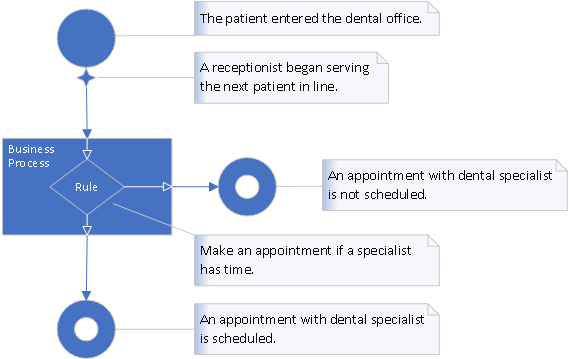
The diagram below shows a high-level model of a dental clinic receptionist’s business process.
Understanding the Diagram
Each shape in the diagram represents one of the business process elements we discussed earlier.
The circle at the top represents the initial state of the business process – the patient has arrived at the dental office.
The small star represents the trigger – the receptionist starts serving the next patient in line.
The large rectangular shape represents the business process itself: servicing a patient’s request for an appointment with a dentist.
The diamond represents a business rule or decision that determines how the process continues.
The donut-shaped symbols represent the final states of the business process – for example, whether an appointment with a dental specialist is scheduled or not.
Why Modeling Matters
A visual model helps us see the structure of a business process at a glance. It makes the flow of work explicit and highlights where decisions are made.
Modeling also creates a shared understanding. Business stakeholders and developers can look at the same diagram and discuss the same process without ambiguity.
In the next chapters, we will gradually move from these visual models toward executable models that can be implemented directly in software.
Table of Content Introduction into Business Process Previous: Business Sub-Process Next: Business Sub-Process Modeling
Business Process Programming in .Net
© 2004–2026 Laskarzhevsky Software Inc.
Unless otherwise noted, the content of this website is licensed under the
Creative Commons Attribution 4.0 International License (CC BY 4.0).
Code examples are provided under the MIT License.
You are free to share and adapt the material provided that appropriate
credit is given and any modifications are clearly indicated.
The information provided on this website is for educational purposes only.
The author and publisher make no warranties regarding the completeness
or suitability of the information and are not responsible for any damages
resulting from its use.